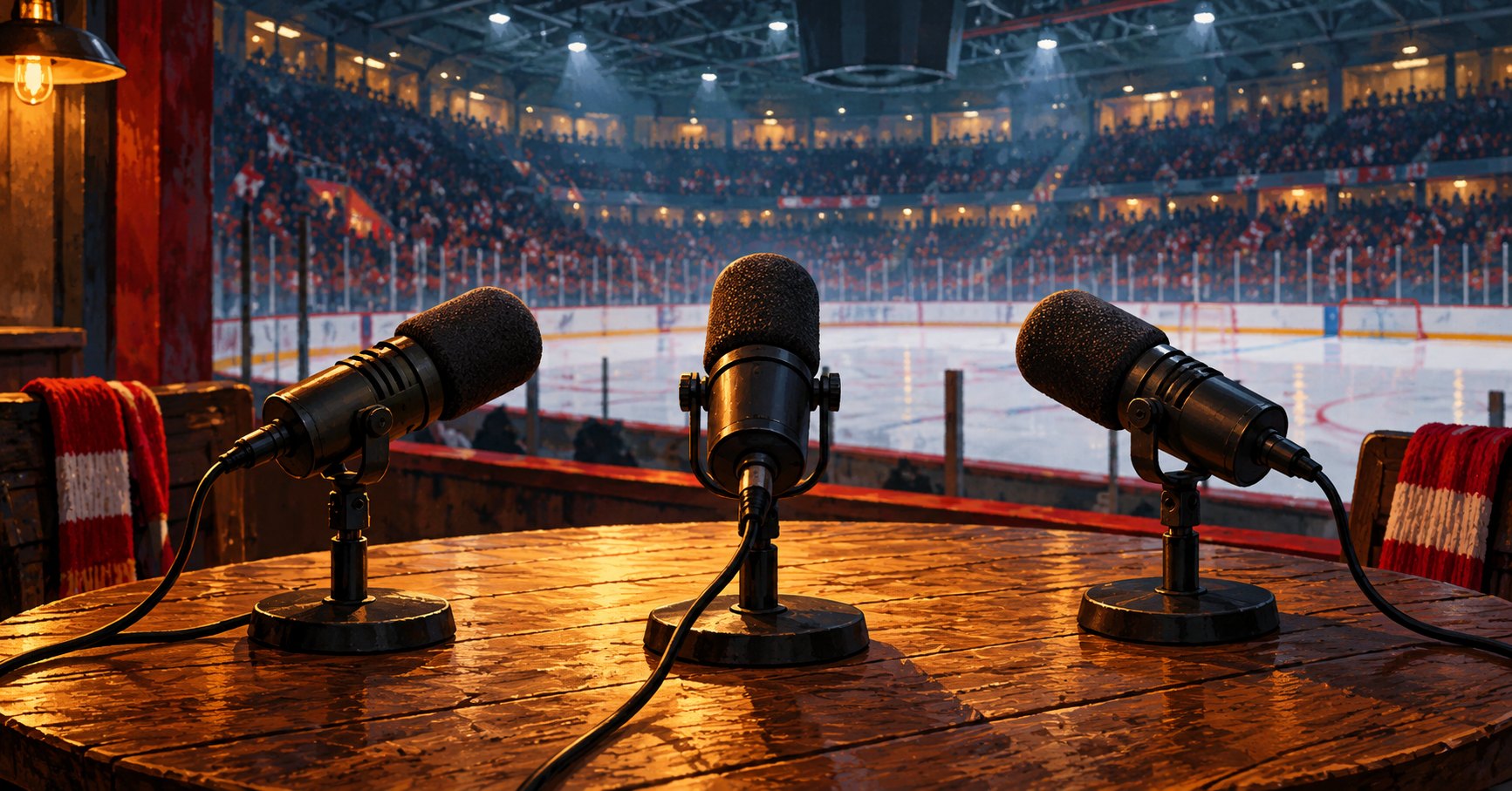
On 4 February 2023, IK beat Luleå 5–0 away from home. The following day brought “Straight from Arlanda: the Luleå rout and the wild chase after the Twitter personality”. Christian Gustafsson and Jesper Hallberg recorded the podcast at Arlanda on their way home from northern Sweden, waiting for their next flight.
The topics included the game, Luleå’s nightlife, IK supporters and the chase after a Twitter personality. That description alone says something about what Ickedickedoa made room for. The people around the team were part of the story too.
That was what following this podcast could be like. You came for a conversation about IK and could end up with music, food, Oskarshamn culture or discussions that had little to do with the next face-off. Detailed hockey knowledge and curiosity about everything around it were allowed to coexist.
A name that already had a response
On 5 September 2014, the newspaper introduced its new hockey podcast. Christian Gustafsson, Johnny Larsson and former IK player Alexander “Acke” Johansson were behind the microphones. IK were playing in Sweden’s second tier. Promotion to the SHL was still almost five years away.
The name came from the stands. The voice calling out Ickedickedoa, with Oskarshamn coming back from the supporters’ section, belongs to Robin Lind, “Ickedickedoa-Robin”. But the chant’s history goes back much further.
According to a story that lives on among supporters, the chant began as a taunt from the Vimmerby crowd, before IK’s climb through the divisions. IK’s supporters are said to have turned the taunt into a chant of their own. Its exact origins have not been established, but Per Sandberg has also recounted a possible Vimmerby connection in an interview with the SHL.
The podcast took its name from that already established chant. It borrowed a piece of the culture around the team that existed long before the first episode.
CG’s years of reporting gave the podcast a sense of history. He was from Oskarshamn himself and had written about IK for both Barometern-OT and Aftonbladet. There was a context in which to place the latest game.
Johnny was also from Oskarshamn. Acke was from Västervik but had twelve seasons with IK behind him. All three had their own history with the club and the town.
The nerdiness was a virtue in itself. Former players, earlier seasons and events around the club could put the present into perspective. There was also room for culture more broadly and the offbeat conversations about style and other things that made these voices more than interchangeable hockey pundits.
From player ratings to Kinapuffar
As early as 10 February 2016, an episode offered ratings for every IK player and a review of Hockeyallsvenskan. The same contents list included “Mellodebatt” and “Tjockistips”. The following year, on 21 February, the discussion covered what might have happened had IK lost to Västerås and their chances of reaching the playoff group. There were also ratings for the acts booked for Latitud 57. The team’s situation and the town’s music scene belonged in the same conversation.
On 30 August 2017, the Hockeyallsvenskan preview arrived with “Kabanov vs Kastak!” in the title. A discussion of the current squad came with a reference back to IK’s history. In September 2018, an episode was devoted to the players’ expected points totals, one by one. There was room here for anyone who wanted to know their team in detail.
The years passed and the tangents continued. In December 2023, “The art of eating Kinapuffar” formed part of an episode title. The description included hockey, café visits and impersonations. The following month, Benny Boquist joined from a skybar in Zug, under the title words “Oskarshamn is home to me”. The podcast could be far from home and still have the same home town.
On 18 March 2024, the episode was titled “Ickedickedoa on the relegation-playoff road: the Godishuset caper in Vetlanda”. Christian and Jesper recorded from the car before and after the second game of the series. Food and Mollie Minott were among the topics. Even when the hockey was at its most nerve-racking, the podcast contained more than the result.
In September 2025, the big points forecast shared space with Godishuset in Verkebäck, municipal slogans and Jeff’s taste in music. A few days earlier, the cultural canon and Per Gessle had featured. The mix was still there after more than a decade.
For those in the know, there was the pleasure of recognition. Those with no connection to Oskarshamn could enjoy the humour, the cultural conversations and the glimpse into a world the hosts knew so well. The niche focus and the broader conversation strengthened each other. There is no shortage of general hockey podcasts. The reason to choose Ickedickedoa lay in what these particular voices, with this particular knowledge and these interests, could do together.
When the podcast was given a different remit
On 28 October 2025, just over eleven years after the premiere, Barometern-OT introduced Nedsläpp: CG & Hallberg. The two main voices at the time remained. The first episode’s description promised a familiar tone and content, but the remit had widened to Hockeyallsvenskan and the newspaper’s three teams: IK, Kalmar HC and Nybro Vikings.
Anders Enström has explained the change in terms of the sports desk’s limited resources. Three teams at the same level were, in principle, to receive equivalent resources, and the desk did not have the capacity for a separate podcast about each team.
That is a concrete explanation for an editorial priority. What value was placed on the distinctive character Ickedickedoa had built, and what alternatives were considered before its remit changed?
Other clubs had already featured in Ickedickedoa. Kalmar, Nybro and the rest of Hockeyallsvenskan appeared before the format change. Cultural conversations and tangents continued afterwards too. What changed was the perspective that would hold together a podcast with a shared remit for three clubs.
The old rivalry with Nybro is so far in the past that many in today’s standing section have only heard stories about it. We have no rivalry with Kalmar whatsoever.
A shared podcast for the three clubs is the wrong approach. We want to follow IK in depth, with our history, our people and our points of reference. Nybro followers have just as much reason to demand a conversation that starts with their own club.
To us, hockey in Kalmar has more of a focus on the event, with the game itself as the main attraction. That does not make the three club communities a single audience. A newspaper’s coverage area does not create a shared supporter identity.
If playing in the same league is enough, you might as well add Östersund. The newspaper’s map makes sense as a way to plan its coverage. But what suggested that it also reflected its listeners’ interests?
The name and the editorial remit can also be separated. Bonnier News’s catalogue includes several podcasts under the Nedsläpp name with an explicit focus on one club, among them Modo, Brynäs and Timrå. A shared brand can coexist with a clear club identity.
That tells us nothing certain about who made the decisions here. It does, however, show why the name change and the broader remit each deserve an explanation. How were the two decisions connected at Barometern-OT? And what did the podcast’s makers themselves think of the change?
Johnny and Acke have carried the conversation forward
IK-podden premiered on 29 May 2026. In July, Johnny Larsson and Acke Johansson were introduced together in IK-panelen. Since September, their recurring episodes have appeared under the name IK-surr Johnny och Acke. Two of Ickedickedoa’s three original voices are back together.
For us, they have brought much of the old spirit with them: the intimate knowledge, the humour, the people around the team and the willingness to let the conversation find its own way. We have a conversation we want to listen to again.
The episode description for 28 September puts local boys Filiph, Joel and Calle at its centre. There are also personal stories about Acke and Johnny. It is easy to recognise what draws us to that mix.
At the same time, there is a difference that matters. IK Oskarshamn publishes IK-podden, in which IK-surr is a recurring format.
What editorial freedom do Johnny and Acke have if they want to ask the club’s management uncomfortable questions? We do not know. The club connection shows who is behind the podcast, but does not, by itself, tell us what editorial rules apply.
A local newspaper has a role of its own: to follow IK closely and be able to scrutinise the club on its own terms. Ickedickedoa combined that possibility with a relationship with its audience. Now that Johnny and Acke have given us something to listen to, it is still worth asking how the newspaper handled that combination.
Have readers started moving on
The questions about the relationship with the audience do not end with the podcast. Our impression of the newspaper’s most-read lists is that IK articles used to dominate. Now we feel they appear much less often, while Nybro articles are roughly where they were before. That is an observation from our side.
Positions on a list do not show how many people have stopped reading or cancelled a subscription. But the change we think we see raises a question: has part of the Oskarshamn audience started spending its time elsewhere?
There are alternatives. Johnny and Acke can be heard in IK-surr, and we at GLID INTE are ourselves part of the supporter conversation taking place elsewhere. You can remain just as committed to IK while choosing other voices to follow.
CG’s changed role is part of the picture too. In August, we wrote about the news that he was no longer part of the sports desk, citing Victor Laag’s reply in the newspaper’s comments section. What might that have meant for those who chose the newspaper specifically for his coverage?
If attention has shifted, the podcast change cannot be treated as the whole explanation. Other voices, changes in coverage and the team’s sporting fortunes may also play a part. But has the newspaper underestimated how much a relationship with an audience can depend on particular people and a particular way of telling a story?
The questions that remain
From where we stand, the change looks like a terrible strategic decision. The newspaper had a podcast with a clear identity and changed the very starting point that made us choose it. If the aim was to make more money, that choice looks to us like an own goal. What was the financial logic in making the podcast less relevant to those of us already listening?
How it actually worked out financially, we do not know. We do not have comparable figures for costs, revenue or listening. Our objection concerns how the value of what already existed was assessed and what the change was expected to deliver.
Some supporters also still suspect that the aim was to favour Kalmar HC as a club. From our perspective, Kalmar seems to be given particular priority in the written coverage too. Was there also an ambition to actively boost Kalmar HC? We have no evidence that such a motive drove the decision.
The explanation about resources is there. IK also continues to be covered in the regional format, for example through the interview with Arsi Piispanen in September 2026. But equivalent coverage does not, in itself, explain why Ickedickedoa’s identity needed to change.
Johnny and Acke have carried the conversation forward. We no longer miss Ickedickedoa. But that does not make the newspaper’s decision any easier to understand.
The name came from the stands. The content could wander far beyond hockey. In between were a team, a long history and people with something of their own to say. You did not have to come from Oskarshamn to appreciate it.
What, exactly, was supposed to get better when the newspaper remade that podcast, and for whom?